
Sounds like an Egyptian monument, right?
In the trading world, pyramiding is a technique for adding to your positions based on price or time. Instead of buying all your shares at once and hoping you nailed the bottom, you build your position in layers.
Bigger layers as you go down. Like a pyramid.

This works for any account size. And if you can get to 100 shares, it unlocks even more strategies—covered calls, collars, strangles—that we use at GKT to generate income.
Let me show you how it works.
Two Ways to Pyramid
1. Price-Based Pyramiding
You buy more shares as the stock drops to predetermined levels.
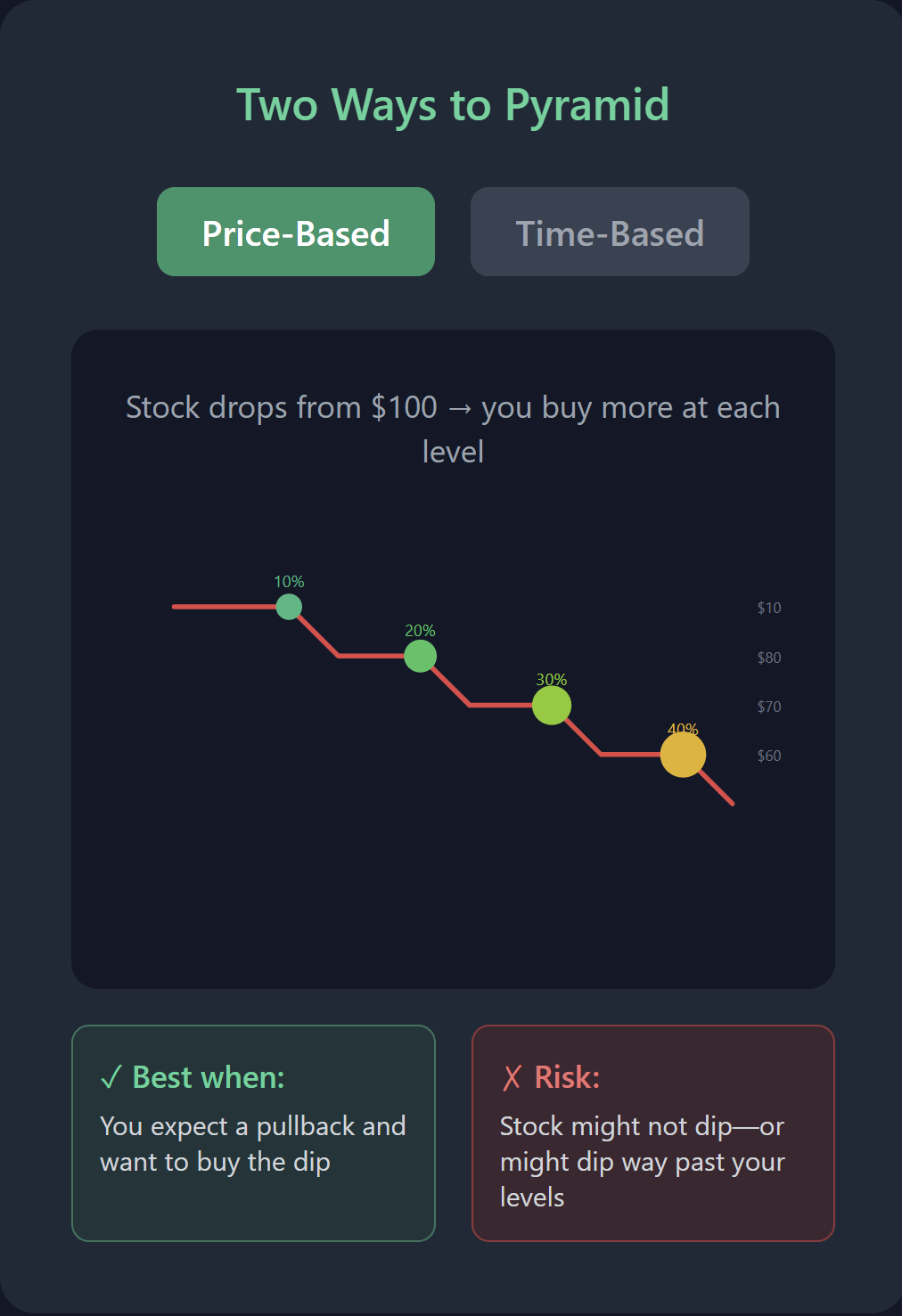
Here’s an example. Say you want to build a position in a stock trading at $100:
- At $100 → buy 10% of your total allocation
- At $80 → buy 20% more
- At $70 → buy 30% more
- At $60 → buy 40% more
You’re adding more weight as the stock pulls back. Your cost basis drops with each purchase. And you’re not betting everything on one entry point.
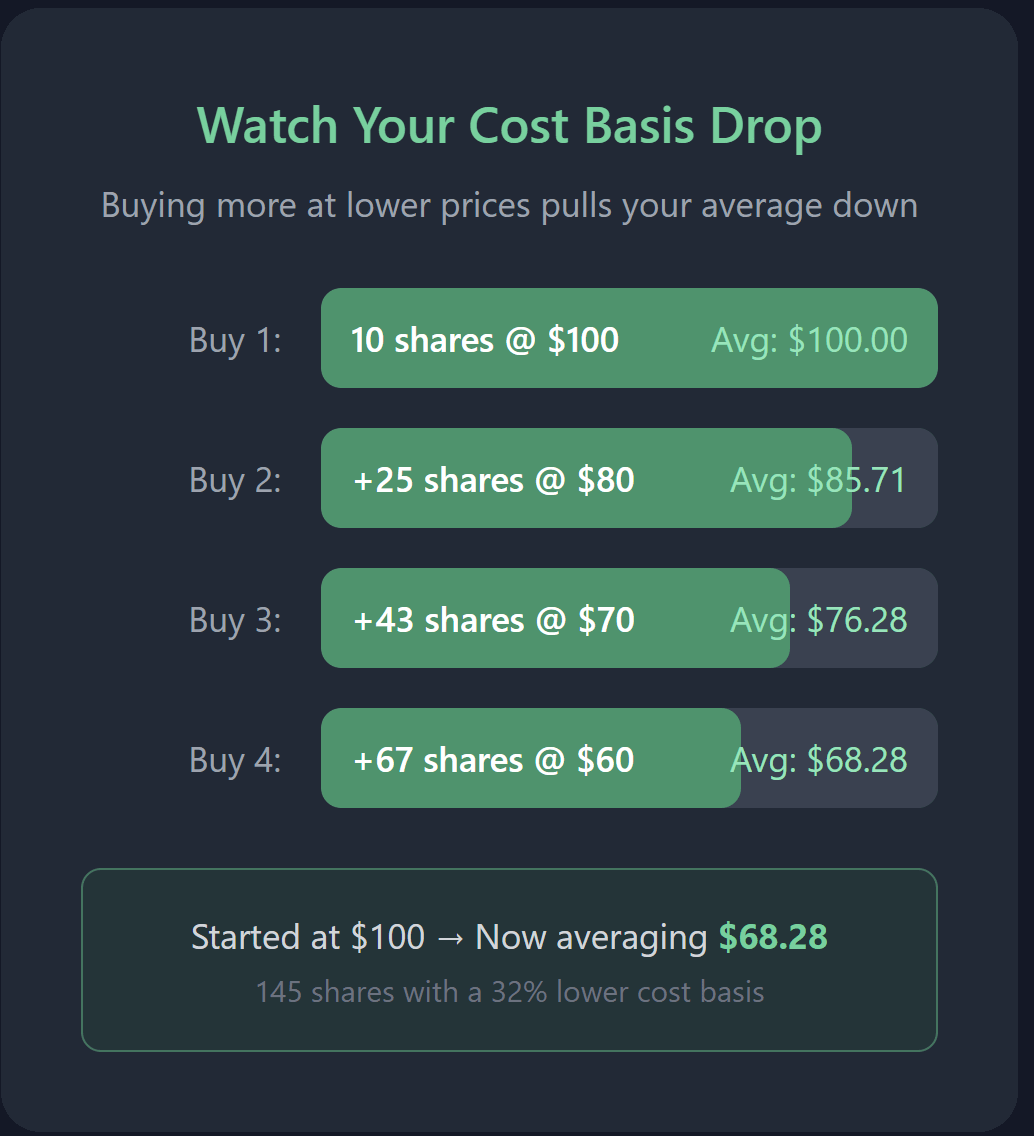
The key: you decide your levels before the stock moves. Not during. Not when emotions are running hot.
2. Time-Based Pyramiding
You buy a fixed amount at regular intervals, regardless of price.
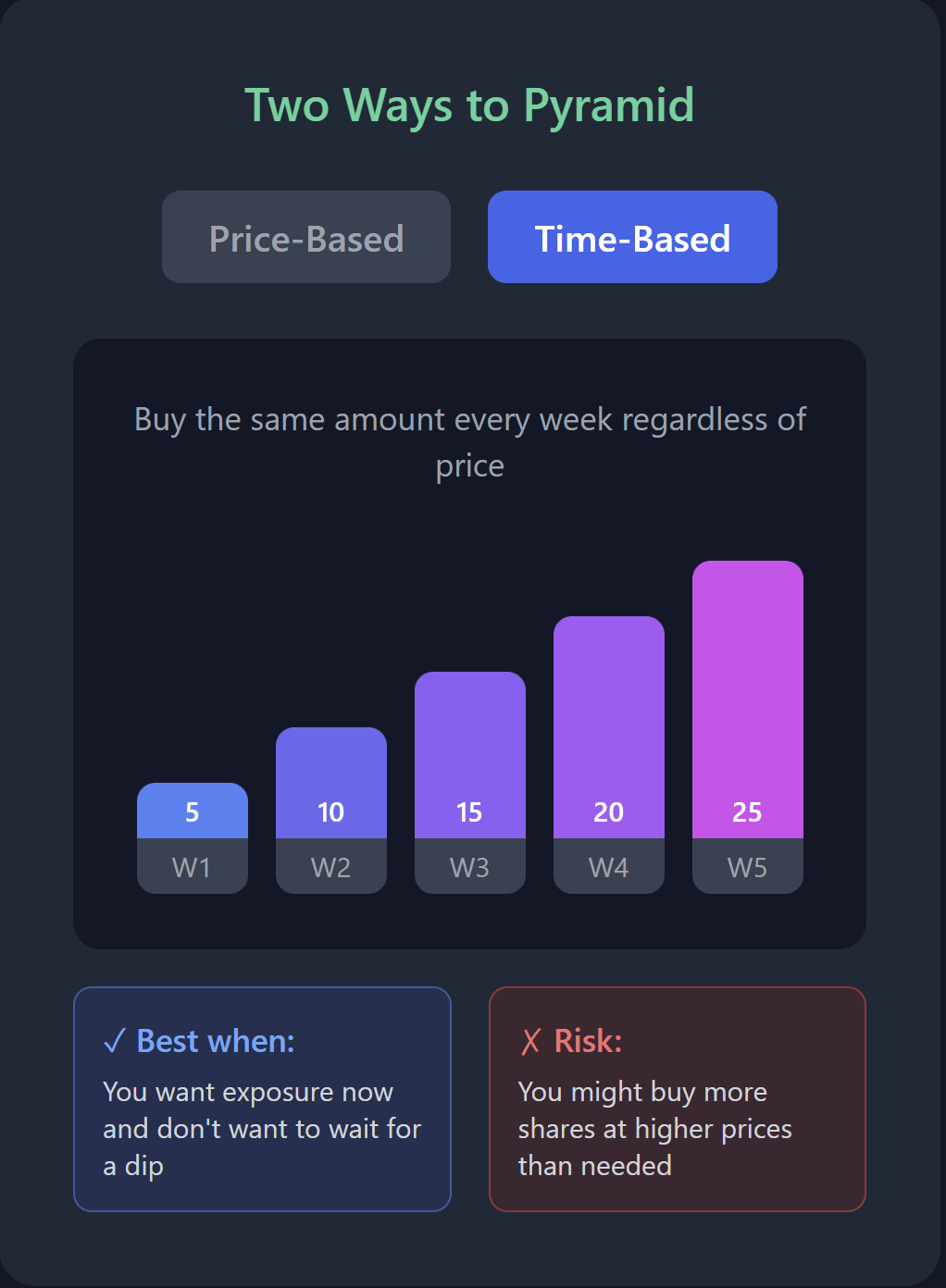
Say you want to put $1,000 into Delta (DAL) at $40 a share. That’s 25 shares total.
Instead of buying all 25 at once, you buy 5 shares every Friday for five weeks. Or 5 shares on the first of each month for five months.
This smooths out price fluctuations. You’re not trying to pick the perfect entry—you’re just accumulating shares over time.
Once a week is the shortest interval I’d ever use. Any faster and you’re just adding noise.
Which Approach Should You Use?
Both have their place.
Price-based pyramiding works great when you believe in a company but think it might pull back. You get to buy low—and buy more as it goes lower.
The problem? Sometimes stocks don’t dip enough to hit all your levels. Or they keep dipping way past where you expected. Neither feels good.
Time-based pyramiding gets you exposure without waiting for a pullback. In a bull market, that’s valuable. You’re building positive delta while everyone else waits for a dip that never comes.
The problem? You might buy more shares at higher prices than you needed to.
There’s no perfect answer. Pick the approach that fits your thesis and your timeline.
How I Pick My Price Levels
When in doubt, I zoom out.
Instead of the daily chart, I look at the weekly. I keep my moving averages on the chart—the 100 and 200 SMA especially.
I draw my buy levels where I see support and where price has respected moving averages in the past. These aren’t random numbers. They’re areas where buyers have stepped in before.
If you want to go deeper, you can use Fibonacci retracements or draw your own support/resistance lines. The tool doesn’t matter as much as having a plan.
The point is: figure out your levels before you need them. Write them down. Stick to the plan.
The Most Important Rule: Have a Line in the Sand
Pyramiding only works if you have an exit plan.
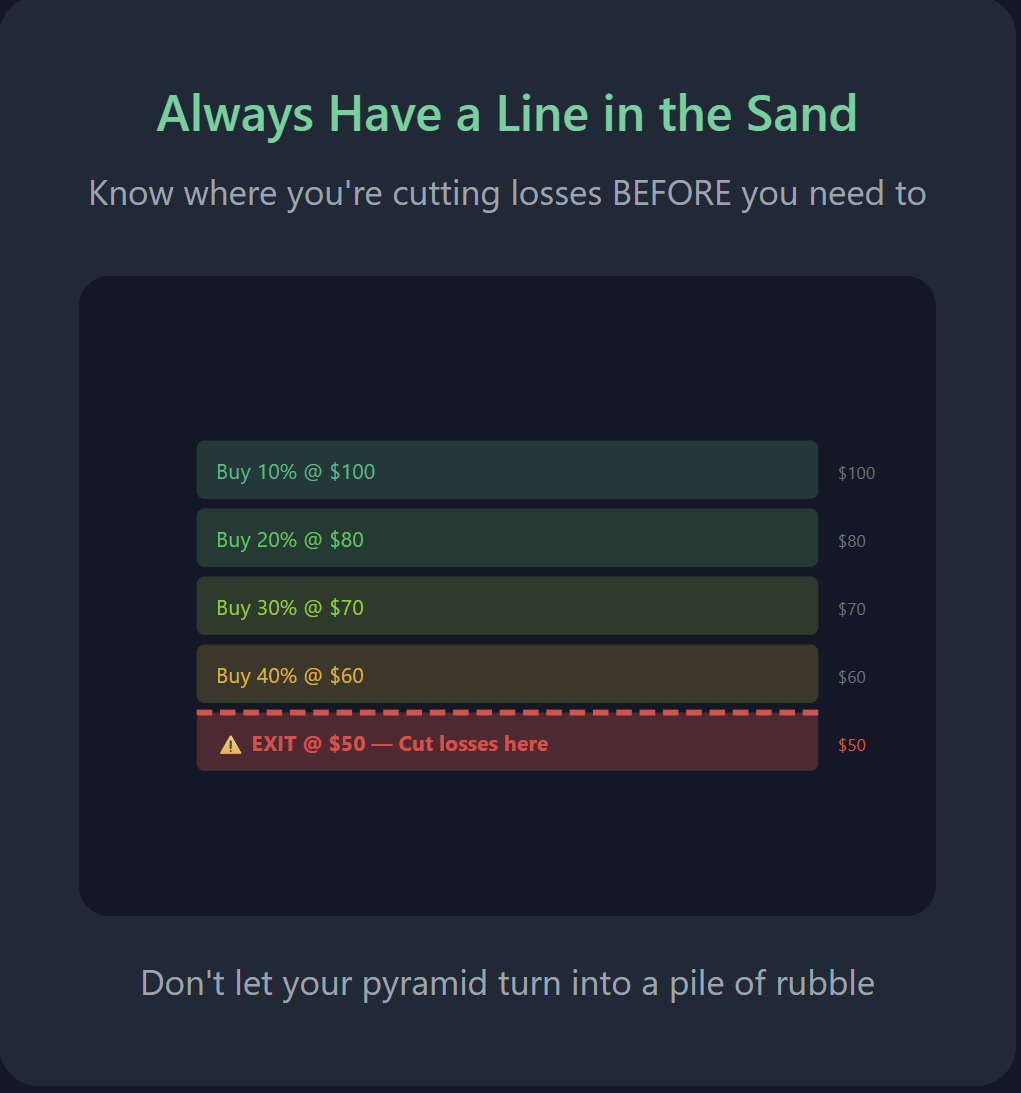
If the stock keeps dropping past all your levels, you need to know when you’re cutting losses. No exceptions. No “I’ll just hold and hope.” Your pyramid can turn into a pile of rubble if you don’t protect yourself.
Have a stop. Or buy protective puts. But have something.
A Variation: Pyramiding with Puts
If you’re more advanced and have the account size, you can pyramid using put sales instead of buying shares outright.
Here’s how it works:
If the stock pulls back to those strikes, you get assigned shares at prices you wanted to buy anyway—plus you collected premium along the way.
If the stock never dips? You keep the premium and move on.
This is more aggressive. You need to understand that if the stock goes to zero, you’re responsible for 100 shares per put you sold. Don’t over-leverage. But in a bull market, this is a solid way to get paid while you wait for your entries.
Why Pyramiding Works
Too many traders wait for “the bottom.”
Here’s the problem: you can’t know it’s the bottom until the stock has already bounced. By then it’s too late.
Pyramiding solves this. You don’t need to be right about the exact bottom. You just need to be right about the company. The structure handles the rest.
It’s systematic. It removes emotion. And it keeps you from going all-in at the worst possible time.
Bottom Line
Pyramiding is a strategy everyone should consider for at least part of their portfolio.

Decide your levels ahead of time. Have a line in the sand for when you’re wrong. And if you can get to 100 shares, you unlock covered calls and other income strategies that make the position work even harder.
Turning knowledge into wealth,
$Maxwell
Thanks for reading! Subscribe for free to receive new posts and support my work.
This is for educational purposes only. I’m not a financial advisor—just a trader who’s been doing this for nearly 30 years. You’re responsible for your own decisions and the buttons you click in your brokerage account.